
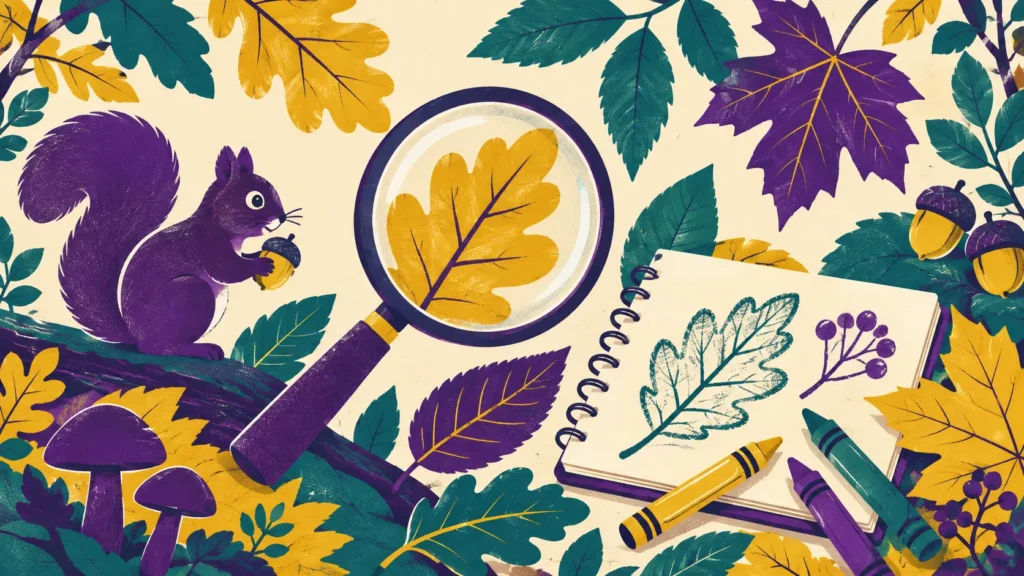
Autumn gives young children plenty to investigate without needing a big day out. A leaf on the pavement, the sound of wind in a hedge or a patch of colour outside a window can start a conversation. For families with Squirrels in Swineshead, these small discoveries offer a relaxed way to keep curiosity going between meetings. The aim is to enjoy noticing things together, with enough time for questions and a little room for surprise.
This guide brings together simple ideas for children aged four to six and the adults alongside them. They are suggestions for family time, rather than a list of activities promised for a particular Squirrels meeting. Choose what suits your child, the space available and the day you are having. Ten happy minutes spent looking closely can be more useful than an ambitious afternoon that leaves everyone tired.
Start with one small question
A broad instruction such as “let’s learn about autumn” can be hard for a young child to grasp. Try something they can investigate immediately instead. Can you see two different leaf shapes? Which colour can you spot most often? What can you hear while we stand still? A clear question gives the activity a starting point without deciding in advance what the answer should be.
Give your child time to answer in their own way. They might point, draw, make a sound or tell you a long story that only partly relates to the question. You can follow their interest and then gently return to what is in front of you. If they notice a wheel, a dog or a cloud instead of a leaf, that is still an opportunity to observe and describe something.
Adults do not need to know the name of every tree. Saying “I’m not sure; let’s look more closely” shows that asking questions is worthwhile. You could remember one question to investigate later, using a suitable book together. Keep the distinction between an observation and a guess: “The leaf has points around the edge” is something you can see, while its species may still be a mystery.
Make a colour hunt that works anywhere
Choose three colours before you begin, perhaps yellow, brown and green. Draw a patch of each on a piece of paper, or simply name them. Look for examples from a window, in a garden or on a short familiar walk with an adult. There is no need to collect anything. Pointing to a colour or sketching it is enough, and leaves the place as you found it.
Once you have found an example, compare it with the colour you expected. Is the yellow pale or bright? Does one leaf have several colours? Children can invent their own descriptions, such as toast brown or sunshine yellow. This turns a hunt into a conversation about differences rather than a race to finish a list. It also gives children who enjoy talking something specific to explain.
If the task feels too easy, ask whether the same colour appears in something made by people and something growing. If it feels difficult, reduce the choice to one colour and help search together. A child does not have to complete every part to have taken part successfully. Finishing while they are still interested makes it easier to return to the idea another day.
Look at shapes before learning names
A simple drawing can reveal details that are easy to miss at first glance. Invite your child to draw the outline of a leaf they can see. It may become a circle, a zigzag or an enormous scribble, and that is fine. Ask which part they noticed first. You can make your own drawing alongside theirs without presenting it as the correct version to copy.
Compare two shapes and talk about their edges, size and symmetry in everyday words. One may look like a hand, another like a long oval. Try describing a shape while the other person guesses which example you mean. This encourages careful language and listening. Avoid turning it into a test of memory; the interesting part is discovering which description helps someone else understand.
Indoors, make paper versions from drawings or use large reusable shape cards. An adult can prepare pieces where cutting would be difficult. Arrange them from smallest to largest, group similar outlines or invent a pattern. These activities work even if you cannot get outside, and they give a second life to the observations made earlier. Leave space for your child to make up a different sorting rule.
Build a tiny observation diary
An observation diary can be one folded sheet rather than a new notebook. Give each visit or window watch a small space. Your child could draw the sky, choose a colour or ask you to write a sentence they dictate. Date the page if that interests them. The purpose is to remember what they noticed, not to produce something that looks polished enough for display.
Return to the same view a few days later and compare it with the drawing. What seems different? What seems unchanged? Perhaps there are fewer leaves, a new puddle or a different sound. Do not worry if the comparison is uncertain. Looking twice is the useful habit. Young children are allowed to change their minds when they see something they did not notice before.
Keep the diary private to your family unless your child wants to share it. If they would like to tell the Squirrels team about their discovery, ask how best to do that. There is no need to publish photographs of children or identify the exact location of a regular walk. A drawing of a leaf can tell the story perfectly well on its own.
Use a simple listen-and-describe game
Choose a comfortable place with an adult nearby and pause for a short listening moment. Eyes can stay open. Ask what sounds seem close and what sounds seem farther away. You might hear a bird, footsteps or a vehicle. Avoid requiring silence for a long period: a few seconds may be plenty, especially for a child who finds waiting difficult.
Back indoors, recreate one sound using your voice or a gentle tap on a surface. Take turns guessing. You could draw a symbol for each sound and arrange the symbols into a made-up story. Someone who prefers not to make a sound can point to a picture instead. Keep the volume comfortable and stop if the game becomes unpleasant rather than enjoyable.
This is also a chance to practise describing without judging. A sound may be quiet, sudden, repeated or low. Different people may notice different things, and neither has to be wrong. Ask “what did you hear?” before offering your own answer. That small change gives your child ownership of the discovery and can produce a more interesting conversation than a series of adult explanations.
Keep the outing manageable
For families around Swineshead and Boston, a familiar accessible place can be a better choice than travelling somewhere new simply for an activity. Think about how long the walk will take, where you can turn back and whether the surroundings suit your child. Stay together, follow local access rules and avoid treating an activity sheet as a reason to enter fields, approach water or leave a safe route.
Choose clothing for the conditions and allow time to return before everyone becomes cold or tired. Leave unknown plants, berries and fungi alone rather than using them as play materials. Paper drawings are a useful alternative to collecting natural objects, especially with younger children who may put things in their mouths. Wash hands after outdoor play and keep snacks separate from the things being investigated.
The plan can change. Wind, rain, a difficult morning or a child who simply wants to go home are all good reasons to shorten it. A window hunt still counts as noticing the world. Offering two realistic choices, such as drawing indoors or taking a short walk, can help your child feel involved without giving them responsibility for decisions that belong to the adult.
A quick activity plan to keep
- Choose: one colour, shape or sound to investigate.
- Notice: let your child point, talk or draw before you explain.
- Compare: find one similarity and one difference.
- Remember: save a drawing or a sentence, if they want to.
- Return: look again another day and see what has changed.
You can use this sequence in five minutes or spread it over a weekend. It is a flexible prompt rather than a timetable. If a child becomes absorbed in the first step, stay there. Curiosity does not need a finished worksheet, and an unfinished drawing can still lead to a useful conversation later.
Connect small discoveries with Squirrels
The national Squirrels information describes the section for ages four to six, with opportunities to play, learn and try new experiences. Our Squirrels section in Swineshead is the place to find local information. These family ideas can complement that wider experience, but they are optional and do not automatically meet the requirements of a badge.
If your child has enjoyed a particular topic, mention it to the leaders. A simple comment such as “they loved looking at leaf shapes” is useful; there is no need for a portfolio. You can also share anything that would help your child take part comfortably. Speak privately to the team about individual needs rather than putting personal information into a public comment.
For practical preparation, visit our Squirrels uniform, badges and Promise resources. Families interested in joining can contact 7th Boston Swineshead to ask about availability and the next step. Autumn offers plenty of small starting points. Let your child choose one thing to notice, give it your attention together, and see where the conversation goes.
 Scouts
 Cubs
Cubs Scouts