
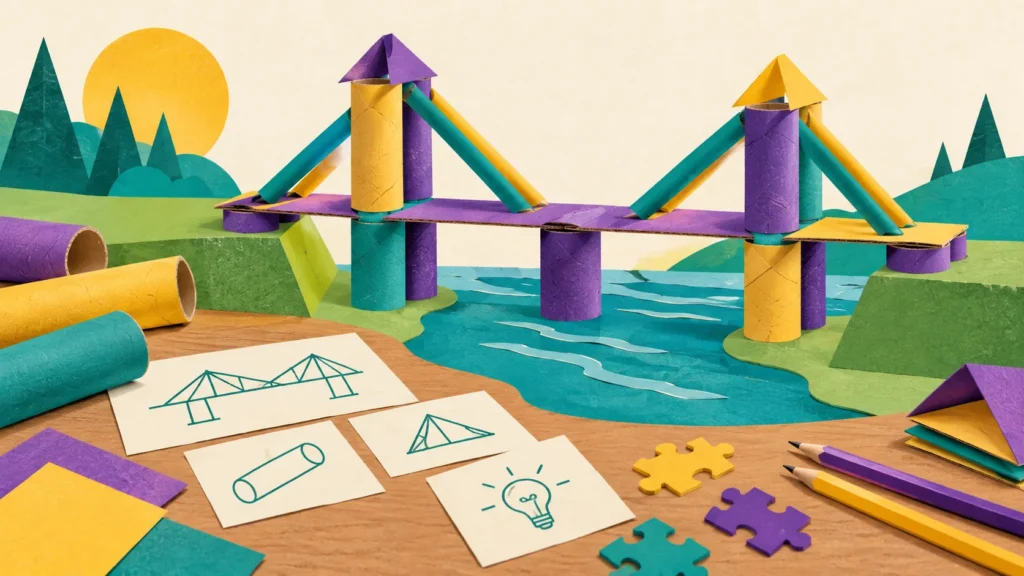
A team challenge can look simple from the outside: a few sheets of paper, a bridge between two books and a small object to carry across it. Inside that task, however, there are decisions to make. Who has an idea? How will the group choose? What happens when the first design bends? For Cubs in Swineshead, those questions connect practical making with the everyday skills of listening, sharing responsibility and trying again.
This article explores what useful teamwork can look like and offers a low-cost challenge families can adapt at home. It is an example of learning through a shared task, not a report of a particular meeting or a promise about the next programme. You do not need special equipment or a large group. Two people can practise many of the same habits around a table.
Give the team a problem worth discussing
Start with a clear task: build a paper bridge across a small gap that can hold a lightweight toy. Place the supports on a stable table and choose a gap that allows early success. Decide which materials can be used before starting. Scrap paper, card and tape are enough. Keep the test low to the surface and use only suitable, lightweight objects.
A good problem leaves room for more than one answer. If an adult shows the finished bridge first, the activity becomes an exercise in copying. Instead, ask how the paper could be made stronger. Could it be folded, rolled or layered? Let the team suggest possibilities, including ideas that may not work. Discussing a suggestion is different from promising to use it.
Make the limits understandable. “We have four sheets and ten minutes to make a first version” gives a clearer starting point than “make the best bridge”. The word best can mean strongest, neatest or fastest, and those goals may conflict. Agree what the test will measure so that everyone is working towards the same purpose. Leave appearance out unless it genuinely matters to the task.
Make space for an idea before choosing one
Confident speakers can unintentionally decide the design before anyone else has joined the conversation. Try giving each person a short opportunity to suggest or sketch an idea. Someone can pass if they want to. Putting ideas on paper can help children who need a moment to think and gives the group something concrete to compare without repeatedly interrupting one another.
Ask a question about each proposal before deciding. What might make it strong? Which part could be difficult? Is there a useful detail that could be combined with another suggestion? These questions keep attention on the design rather than the person who proposed it. A child can disagree with an idea while still treating its owner with respect.
For a small family challenge, you might agree to test two designs rather than vote immediately. In a larger group, choosing one version may be more practical. Either way, explain the decision and recognise the ideas that helped shape it. Being heard does not mean always getting your first choice, but it should mean understanding that your contribution was considered.
Share jobs without fixing labels on people
A bridge needs planning, making and testing. One person might prepare the paper while another checks the gap. Someone else could record what happens during the test. These are temporary jobs, not permanent labels such as “the clever one” or “the artistic one”. Children should have opportunities to try unfamiliar roles, with help where needed.
Keep the jobs meaningful and proportionate to the size of the group. If there are only two people, dividing every tiny action can make the activity awkward. Agree who begins each part and change over during the second attempt. If one task is difficult for someone, adapt it rather than quietly removing their contribution. A child can explain a plan while another person does the fiddly taping.
It helps to say what a role involves. A tester is checking the agreed design, not trying to destroy someone else’s work for a laugh. A recorder is noticing what happened, not deciding who deserves blame. Clear descriptions reduce arguments and give children useful language for working together. They can also make it easier to ask for help without feeling that they have failed.
Use the first test to gather information
Put the lightweight object on the bridge gently and observe what changes. Does the middle bend? Do the ends slide? Does one fold hold its shape better than another? The answer should describe the bridge rather than judge the builders. “The paper folded in the middle” gives the team something to work with; “we are rubbish at this” does not.
Invite each person to say one thing they noticed. If the bridge works, do not assume there is nothing left to learn. Ask which feature seems most important and how the team could check that. If it does not work, reduce the challenge or change one part. The first version is useful because it makes the problem visible.
Avoid adding more weight until something dramatic happens. The purpose is to compare ideas, not create a spectacular collapse. Keep the test small and controlled, and stop before objects could fall or materials become awkward to handle. Adults remain responsible for choosing suitable equipment and supervising the activity. Paper engineering should stay a tabletop game, not become a structure anyone stands on.
Change one thing and try again
Choose a single change for the second version. It might be a different fold, an extra support or a shorter gap. Ask the team to explain why they expect it to help. Making a prediction does not mean they have to be right. It gives them a reason to pay attention when they test the new version.
If everything changes at once, it becomes difficult to understand why the result improved. Keeping most things the same makes the comparison clearer. A quick sketch of each version can be enough to record it. Children who enjoy detail could add a note about the materials, while others might draw an arrow showing the part that bent.
Decide together when to stop. Repeating a challenge can be absorbing, but a tired team may become frustrated over small details. Finishing after two thoughtful attempts can be more productive than insisting on a perfect result. Ask what they would try next if they returned to it. That leaves the idea open without requiring another round immediately.
Handle disagreement as part of the task
Disagreement is not automatically a sign that a team is failing. It may mean people have different priorities or have noticed different problems. Slow the conversation down and ask each person to describe what they want to change. Encourage specific language: “I think the middle needs another fold” is easier to discuss than “your idea is wrong”.
When frustration rises, take a brief pause and return to the shared goal. The adult can help restate the options without choosing a winner based on who speaks loudest. For a low-stakes activity, testing both suggestions may settle the question more fairly than arguing. If that is not possible, agree a simple decision method before restarting.
It is also fine to acknowledge disappointment. A child may have put effort into an idea that the group does not use. Thank them for the contribution and identify something specific it helped the team understand. Avoid pretending that every suggestion is equally suitable. Honest, kind feedback gives a more useful picture of collaboration than praise that does not relate to what happened.
A teamwork prompt card
- Before: What are we trying to achieve, and what can we use?
- Listen: Has everyone had a way to contribute an idea?
- Build: Does each person know their current job?
- Test: What happened to the design?
- Improve: Which one change shall we try?
- Reflect: What helped us work together?
Keep these questions nearby if they help, but do not turn every moment into a formal discussion. Children need time to make and play. One useful question at the right moment can do more than a long explanation while everyone is waiting to start.
Notice the teamwork as well as the bridge
At the end, ask for an example of something another person did that helped. Perhaps they held the paper still, listened to a concern or suggested a way to share the tape. Specific recognition makes cooperation visible. It also shows that a successful contribution can be quiet and practical rather than being the person with the original idea.
Reflect on one thing to change next time. Would clearer jobs help? Was the gap too ambitious? Did the team begin building before agreeing a design? Keep this conversation short and balanced. The aim is to leave with one useful insight, not to conduct a detailed review of every disagreement. Adults can name something they would do differently too.
For families in Swineshead and the wider Boston area, these habits can carry into ordinary shared tasks such as organising a game or planning what to take on a day out. That does not mean every family activity needs a learning objective. It simply means children can practise cooperation in situations where the outcome matters a little and the atmosphere stays supportive.
Find out about Cubs in Swineshead
The national Cubs page introduces the section for young people aged eight to ten and a half. Our Cubs section page explains the local opportunity at 7th Boston Swineshead. Shared challenges are one way to explore the wider idea of learning new skills with other people, although individual activities and programme plans vary.
Families can use our Cubs resources for uniform, badge-placement and Promise information, and contact the team about joining or supporting their child. If you try the bridge idea, ask your Cub what they would change before telling them your own answer. The most interesting result may be the explanation they give, rather than the bridge left on the table.
 Scouts
 Squirrels
 Scouts